Food Allergy Test | Parent Guides
Is Your Child’s School Allergy-Ready? A Parent’s Checklist for 2026
Updated 11 July 2026 | Based on new DfE statutory guidance for England
Every school in England now has to follow new government rules on keeping pupils with allergies safe. That’s good news — but it also means there’s a fresh set of things worth checking with your child’s school before term starts. Rather than walking through the guidance clause by clause, we’ve turned it into a practical checklist you can actually use, plus where testing fits in if you’re still not sure what your child reacts to.
Why Schools Have New Rules to Follow
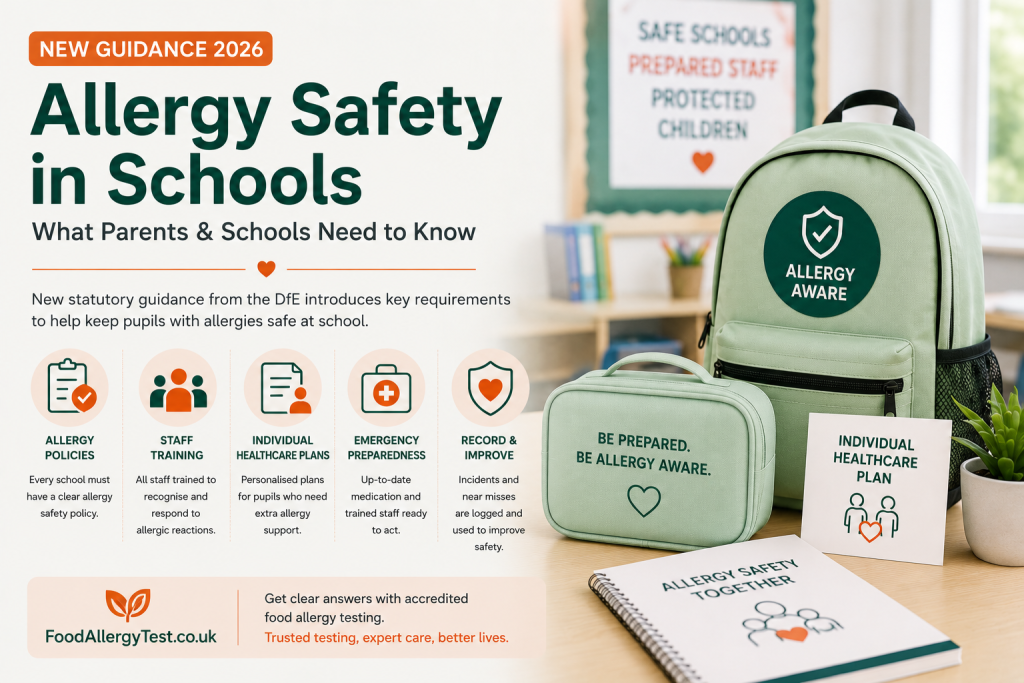
In July 2026, the Department for Education published its first-ever statutory guidance on allergy safety. “Statutory” simply means it isn’t optional advice — maintained schools, academies, free schools and pupil referral units are now required to follow it. Independent schools are currently exempt, though that’s expected to change as the requirements are folded into wider school standards.
The short version: schools can no longer treat allergy management as something left to individual staff goodwill. There has to be a policy, training, and paperwork behind it.
The 5-Point Checklist for Parents
1. Has the school published an allergy safety policy?
Every school covered by the guidance must have a written policy explaining how it prevents and manages allergic reactions. Ask to see it, or check whether it’s on the school website.
2. Does your child have an up-to-date Individual Healthcare Plan (IHP)?
An IHP is a personalised document covering your child’s specific triggers, symptoms, medication and emergency steps. If your child’s diagnosis has changed, or they’ve never had one, this is the moment to sort it.
3. Have staff actually been trained — not just the first-aid team?
The guidance requires allergy awareness training to reach all staff who come into contact with pupils, including lunchtime supervisors and teaching assistants, not only the school nurse.
4. Is your child’s adrenaline auto-injector (AAI) in date and correctly stored?
Schools are expected to know how many AAIs they hold, where they’re kept, and how to check expiry dates. It’s worth confirming this directly rather than assuming it’s been done.
5. Does the school log incidents and near misses?
Under the new guidance, schools must record allergic reactions and close calls, not just full-blown emergencies. This is what allows a policy to actually improve over time.
What If You’re Not Actually Sure What Your Child Is Allergic To?
An Individual Healthcare Plan is only as good as the information behind it. If your child has had reactions but you don’t have a confirmed diagnosis — or you suspect an allergy but have never had it tested — that’s the gap worth closing first. A vague “possible nut allergy” note doesn’t give a school much to work with; a confirmed result does.
This is where Food Allergy Test comes in. We provide accredited food allergy testing with clear, easy-to-read results that you can hand straight to your GP or your child’s school when completing their IHP.
Not sure where to start? Book a food allergy test before the new term begins, so you’re walking into that first conversation with your child’s school with real answers, not guesswork.
Where to Read the Full Guidance
This checklist is for general guidance only and isn’t a substitute for medical advice. Speak to your GP or an allergy specialist about your child’s individual needs.
