
Advanced PCR stool testing for gastrointestinal infections, including bacteria, viruses and parasites, plus H. pylori stool antigen detection. Simple home sample collection with secure online results.
EORD, HBAG (PCR and H. Pylori stool test for infections)
£438.00
Description
Comprehensive Stool Testing Using Molecular PCR and Antigen Detection
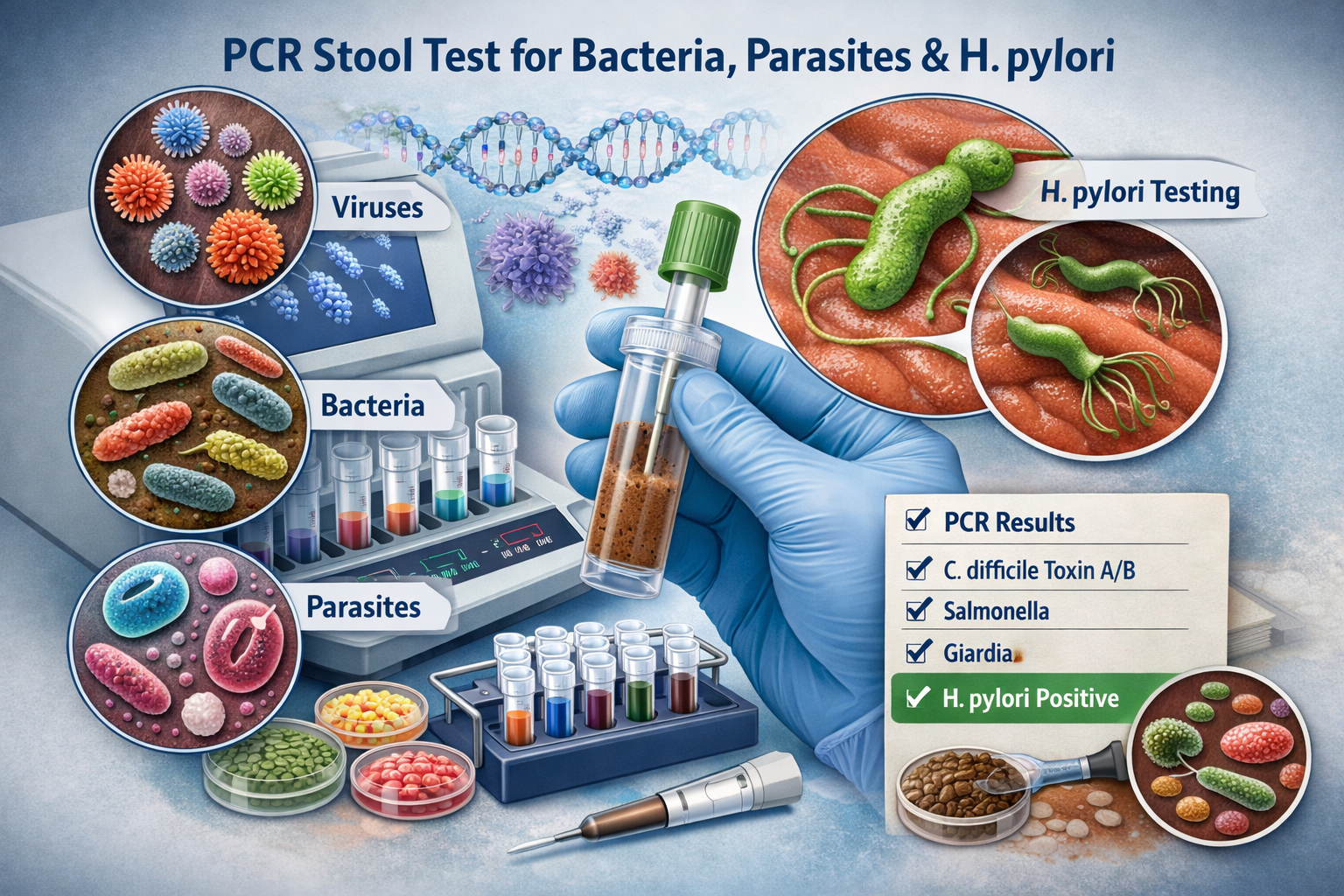
Our stool infection testing panel combines PCR molecular testing for bacteria, viruses and parasites with stool antigen detection for Helicobacter pylori (H. pylori).
This approach provides accurate, non-invasive diagnosis of gastrointestinal infections that may cause diarrhoea, abdominal pain, bloating, nausea, weight loss, fever, or persistent digestive symptoms.
🔬
PCR Molecular Testing
Detects genetic material from bacteria, viruses and parasites with high sensitivity — even at low levels of infection.
⚠
Stool Antigen Test
The preferred non-invasive method for detecting active H. pylori infection, validated for both diagnosis and test of cure.
✔
Combined Accuracy
Combining both methods in one panel improves overall diagnostic accuracy and avoids the need for invasive procedures.
🏠
Test from Home
A postal collection kit is sent to you directly. No clinic visit required for sample collection.
What Does the Stool Test Detect?
PCR Detection
Viral Pathogens
These viruses are detected using PCR molecular testing, which identifies viral genetic material directly from stool.
| Pathogen | Clinical Significance |
| Adenovirus F40/F41 | Common cause of diarrhoea in children |
| Astrovirus | Associated with mild to moderate gastroenteritis |
| Norovirus GI/GII | Highly contagious cause of vomiting and diarrhoea |
| Rotavirus A | Leading cause of severe diarrhoea in infants and young children |
| Sapovirus (GI, GII, GIV, GV) | Causes viral gastroenteritis |
PCR Detection
Bacterial Pathogens
These bacteria are detected using PCR, allowing sensitive identification even at low levels.
| Pathogen | Clinical Significance |
| Clostridioides difficile toxin A/B | Linked to antibiotic-associated colitis |
| Campylobacter spp. | Common foodborne bacterial infection |
| Salmonella spp. | Causes gastroenteritis and systemic infection |
| Enteroaggregative E. coli (EAEC) | Persistent diarrhoea |
| Enteroinvasive E. coli / Shigella | Dysentery-like illness |
| Enterotoxigenic E. coli (ETEC) | Traveller’s diarrhoea |
| Enteropathogenic E. coli (EPEC) | Infant diarrhoea |
| Shiga-toxin producing E. coli (STEC stx1/stx2) | May cause severe haemolytic disease |
| E. coli O157 | Associated with bloody diarrhoea |
| Vibrio cholerae | Severe watery diarrhoea |
| Vibrio parahaemolyticus | Seafood-associated gastrointestinal illness |
| Vibrio vulnificus | Rare but serious infection |
| Yersinia enterocolitica | May mimic appendicitis |
| Plesiomonas shigelloides | Water-related diarrhoeal illness |
PCR Detection
Parasitic Pathogens
Parasites are detected using PCR molecular techniques, which are more sensitive than traditional microscopy.
| Pathogen | Clinical Significance |
| Cyclospora cayetanensis | Prolonged watery diarrhoea |
| Cryptosporidium | Persistent diarrhoea, especially in children and immunocompromised patients |
| Entamoeba histolytica | Amoebic colitis and liver abscess |
| Giardia lamblia | Bloating, malabsorption and chronic diarrhoea |
Stool Antigen Test — Important Distinction
Helicobacter pylori (H. pylori)
H. pylori is not detected by PCR in this panel. It is detected using a separate stool antigen test (SAT), which identifies active infection by detecting H. pylori proteins shed in stool.
- Stool antigen testing confirms active H. pylori infection (unlike blood antibody tests, which may remain positive long after eradication)
- Clinically validated and non-invasive
- Suitable for both initial diagnosis and post-treatment test of cure
- Sensitivity and specificity exceeding 95% with monoclonal antibody-based assays
H. pylori infection is associated with gastritis, peptic ulcer disease, and is classified as a Group 1 carcinogen by the World Health Organisation. Eradication is recommended under both NICE and Maastricht/Florence guidelines.
Sample Collection and Testing Instructions
This test can be completed remotely from home. After payment, you will receive a stool collection pot by post.
1
Label the Pot Before You Collect
Before collecting the sample, clearly write your full name and date of birth on the stool pot. This step must be completed first.
2
Collect Sufficient Sample
Please collect at least ¾ of the stool pot to ensure there is enough sample for both the PCR and antigen tests. Ensure the lid is tightly closed after collection.
3
Include the Laboratory Form
Print the laboratory form sent to you by email and include it with your sample. Do not modify the form or add any additional information. Include all items received in the kit.
Returning Your Sample
Option 1
Laboratory Drop-Off — London
Bring your printed laboratory form and stool pot (filled to at least ¾ full) to:
Laboratory Reception
76 Wimpole Street
London W1G 9RT
Opening hours:
Monday–Friday: 7:00am–7:00pm
Saturday: 7:00am–1:00pm
A map is included on the second page of your laboratory form.
Option 2
Postal or Out-of-Hours (24/7)
Postal samples and out-of-hours drop-offs should be sent to:
Main Laboratory
The Halo Building
1 Mabledon Place
London WC1H 9AX
United Kingdom
⚠ Important Reminders Before You Post
- Write your full name and date of birth on the stool pot before collecting your sample
- Fill the pot to at least ¾ full to ensure sufficient sample for both tests
- Include the printed laboratory form — do not modify or add to it
- Return all items received in the kit
- Order this test on its own — do not add other tests in the same checkout transaction
- If you have any questions, please contact us before sending the sample
Viewing Your Results
Results are uploaded securely to your online patient portal. You will be notified when they are ready.
🔒 View your results:
https://ukallergy.carebit.co/patients/accounts/login
👤 Create an account in advance:
https://ukallergy.carebit.co/patients/accounts/sign-up
If you do not create an account in advance, one will be created automatically when your results are ready.
📋 Ordering Information — Important
This test must be ordered on its own. Please do not add any other tests in the same checkout transaction, as this can cause processing errors with the laboratory.
Please note: This test is intended for patients aged 18 and over unless otherwise advised. Results should be interpreted in the context of your clinical history by a qualified healthcare professional. A positive result does not constitute a diagnosis in isolation. If you are experiencing severe symptoms such as bloody stools, vomiting blood, high fever or significant weight loss, please seek urgent medical attention rather than waiting for test results.


