Description
House dust mites are microscopic organisms found in household dust, especially in mattresses, pillows, duvets, carpets, curtains, soft toys and upholstered furniture. For many people, the proteins found in house dust mite faecal particles and body fragments can trigger an IgE-mediated allergic reaction affecting the nose, eyes, lungs and skin.
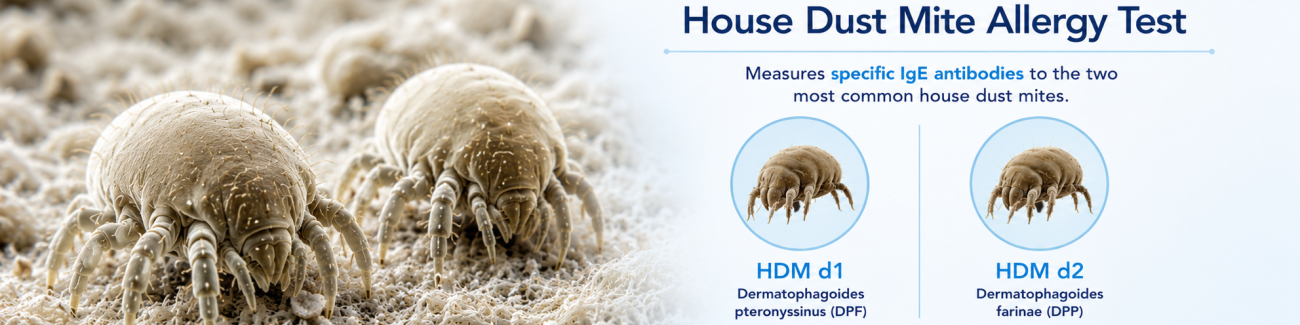
Our House Dust Mite Allergy Test measures specific IgE antibodies to the two most clinically important house dust mite allergens: Dermatophagoides pteronyssinus (d1) and Dermatophagoides farinae (d2). These are the main house dust mite species associated with indoor allergy symptoms in the UK and Europe.
Symptoms of house dust mite allergy
House dust mite allergy often causes symptoms all year round, rather than only during the pollen season. Symptoms may be worse in the bedroom, first thing in the morning, after vacuuming, when making the bed, or in damp and poorly ventilated rooms.
Frequent sneezing — especially on waking, when cleaning, or after disturbing bedding and soft furnishings
Blocked or runny nose — persistent nasal congestion, watery discharge or an itchy nose
Postnasal drip — mucus dripping down the throat, throat clearing or a persistent tickly cough
Itchy, watery eyes — red eyes, swollen eyelids, irritation or morning eye symptoms
Coughing — particularly at night, early morning, or when lying down
Wheezing or breathlessness — asthma-type symptoms triggered by indoor allergen exposure
Chest tightness — a tight, heavy or restricted feeling in the chest, especially at night
Eczema flare-ups — itchy, inflamed, dry or red skin that worsens indoors or overnight
⚠️ When to seek urgent medical help
If you experience severe breathlessness, blue lips, difficulty speaking in full sentences, chest tightness that is rapidly worsening, or signs of a severe asthma attack, seek urgent medical help immediately. Call 999 if symptoms are severe or life-threatening.
What is house dust mite allergy?
House dust mite allergy is an immune-mediated hypersensitivity reaction to proteins produced by house dust mites. These proteins are found mainly in mite faecal particles and body fragments. When inhaled or brought into contact with the skin or eyes, they can trigger an allergic inflammatory response in sensitised individuals.
Unlike seasonal hay fever, which is usually driven by pollen, house dust mite allergy is often perennial, meaning it can cause symptoms throughout the year. This is because house dust mites live indoors and are constantly present in soft furnishings and bedding.
-
◆
House dust mite allergy is strongly associated with perennial allergic rhinitis, causing year-round nasal symptoms. -
◆
It can trigger or worsen asthma symptoms, including cough, wheeze, night-time breathlessness and chest tightness. -
◆
It may contribute to eczema flare-ups, particularly in people with atopic dermatitis. -
◆
Symptoms are often worse in bedrooms because mattresses, pillows and duvets provide an ideal warm and humid environment for mites. -
◆
Diagnosis should combine an allergy-focused clinical history with evidence of sensitisation, such as specific IgE testing.
Why test both d1 and d2? The two most important house dust mite species tested in clinical allergy diagnostics are Dermatophagoides pteronyssinus (d1) and Dermatophagoides farinae (d2). Testing both gives a clearer picture of sensitisation to the main indoor mite allergens relevant to respiratory allergy.
Why can house dust mite allergy be a serious problem?
House dust mite allergy is not simply “a bit of dust irritation”. For many people, it causes persistent inflammation of the nose and airways. This can affect sleep, concentration, school or work performance, exercise tolerance and quality of life.
Because the allergen is present indoors all year round, symptoms can become chronic. Some patients believe they constantly have colds, sinus problems or unexplained breathing symptoms, when the underlying issue is allergic sensitisation to house dust mites.
Identifying house dust mite allergy can help guide practical allergen-reduction measures, appropriate medication, asthma review where needed, and specialist discussion about allergen immunotherapy for suitable patients with persistent symptoms.
What does this allergy test measure?
This is a specific IgE blood test. It measures IgE antibodies in your blood against the two main house dust mite allergens:
| Allergen code | Allergen tested |
|---|---|
| d1 | Dermatophagoides pteronyssinus — house dust mite |
| d2 | Dermatophagoides farinae — house dust mite |
A positive result means your immune system has produced IgE antibodies to house dust mites. Your result should be interpreted alongside your symptoms and medical history, as sensitisation does not always mean the allergen is definitely causing symptoms.
How the test works
You can complete this test remotely from home using a finger-prick sample, or you can have your blood sample collected in the laboratory.
Order & receive
Your home kit is sent to you with lancets, collection materials, instructions and return packaging.
Collect your sample
Collect a small finger-prick blood sample at home using the step-by-step instructions provided.
Post it back
Return your sample to the laboratory using the packaging provided with your kit.
Receive results
Your results are uploaded to your secure patient portal once laboratory analysis is complete.
Why choose our house dust mite allergy test?
Targeted allergy testing
Measures specific IgE to both major house dust mite allergens: d1 and d2.
Home or laboratory collection
Choose remote finger-prick collection or laboratory blood collection, depending on your preference.
Specific IgE blood test
A laboratory-based test measuring allergen-specific IgE antibodies in your blood.
No need to stop antihistamines
Unlike skin prick testing, specific IgE blood testing is not affected by antihistamine use.
Secure results portal
Your results are delivered privately through your secure online patient portal.
Add other allergens
Remote testing allows up to 3 allergens from one sample; laboratory collection has no allergen limit.
Test details at a glance
- ✓Allergens tested: d1 Dermatophagoides pteronyssinus and d2 Dermatophagoides farinae
- ✓Test type: Specific IgE blood test
- ✓Sample: Finger-prick blood sample for remote collection
- ✓Collection: Remote home collection or laboratory collection
- ✓Remote collection: maximum of 3 allergens from one tube, so only 1 additional allergen can be added to this test
- ✓Laboratory collection: no limit on the number of allergens requested from the same sample
- ✓Results delivered to your secure patient portal
How can house dust mite allergy be managed?
If your result confirms sensitisation and your symptoms match house dust mite allergy, management may include environmental control, medication and specialist allergy advice.
-
◆
Use allergen-proof mattress, pillow and duvet covers. -
◆
Wash bedding regularly at high temperature where fabric care instructions allow. -
◆
Reduce indoor humidity and improve ventilation, as mites thrive in warm and humid environments. -
◆
Reduce dust reservoirs such as heavy curtains, old carpets and unnecessary soft furnishings where possible. -
◆
Consider regular cleaning using a vacuum cleaner with a HEPA filter. -
◆
Speak to a clinician about antihistamines, nasal corticosteroid sprays, asthma management or allergen immunotherapy if symptoms are persistent.
Frequently asked questions
Can you really be allergic to house dust?
Many people say they are “allergic to dust”, but the allergy is often caused by house dust mite proteins found in mite faecal particles and body fragments. These allergens can trigger sneezing, congestion, itchy eyes, cough, wheeze and eczema flare-ups.
What is the difference between d1 and d2 house dust mite allergens?
d1 refers to Dermatophagoides pteronyssinus and d2 refers to Dermatophagoides farinae. Both are important house dust mite species used in clinical allergy diagnostics. Testing both helps assess sensitisation to the main house dust mite allergens.
Is this the same as a skin prick test?
No. This is a blood test measuring specific IgE antibodies. Skin prick testing measures an immediate skin response to allergen exposure. Both methods can be useful, but blood testing can be done remotely and does not require stopping antihistamines.
Do I need to stop antihistamines before this test?
No. Antihistamines do not affect specific IgE blood test results. This is one of the advantages of blood testing compared with skin prick testing.
Can house dust mite allergy cause asthma symptoms?
Yes. House dust mite allergy is a common trigger for allergic asthma. It may cause coughing, wheezing, chest tightness or breathlessness, particularly at night or in the early morning. If you have asthma symptoms, you should discuss them with a healthcare professional.
Can house dust mite allergy affect eczema?
Yes. In some people with atopic eczema, house dust mite sensitisation may contribute to worsening skin symptoms, particularly itching, redness and night-time flares.
Can I test other allergens at the same time?
Yes. If your sample is collected remotely, a maximum of three allergens can be tested from one tube. Because this product already includes two allergens, only one additional allergen can be added. If the sample is collected in the laboratory, there is no limit on the number of allergens that can be requested.
How do I access my results?
Your results will be uploaded to your secure patient portal. Please create your portal account before testing at ukallergy.carebit.co/patients/accounts/sign-up.
What should I do if my result is positive?
A positive result should be interpreted together with your symptoms. If your symptoms are consistent with house dust mite allergy, you may benefit from allergen reduction, appropriate medication, asthma review where relevant, and specialist allergy advice. Some patients with persistent symptoms may be suitable for house dust mite immunotherapy.
Medical references
- British Society for Allergy and Clinical Immunology (BSACI) guideline for allergic and non-allergic rhinitis.
- Allergic Rhinitis and its Impact on Asthma (ARIA) guidance on allergic rhinitis and asthma links.
- European Academy of Allergy and Clinical Immunology (EAACI) guidance on IgE-mediated allergy diagnosis and allergen immunotherapy.
- Global Initiative for Asthma (GINA) strategy documents on asthma triggers and allergic asthma management.
- Allergy UK information on house dust mite allergy, rhinitis, asthma and eczema.
This allergy test is suitable for remote self-collection or laboratory sample collection. Remote collection supports a maximum of 3 allergens per sample; as this test includes two allergens, only one additional allergen can be added to the same remote sample. Laboratory collection has no limit on the number of allergens requested. Results are delivered to your secure patient portal. This test is for informational and diagnostic support purposes and does not replace medical advice. If you have severe breathing symptoms or suspect a medical emergency, call 999 immediately.